How Invoice Factoring Works: A Complete Guide for Business Owners
Cash flow challenges affect businesses of all sizes, but the solution doesn't always require taking on debt. Invoice factoring provides immediate working capital by converting your outstanding invoices into cash, enabling you to cover expenses, seize growth opportunities, and maintain smooth operations without waiting 30, 60, or 90 days for customer payments.
This comprehensive guide explains exactly how invoice factoring works, from the initial application through ongoing operations, empowering you to determine whether this financing solution aligns with your business needs.
The Invoice Factoring Process: Step by Step
Understanding the factoring process demystifies this powerful cash flow tool and helps you prepare for a smooth implementation.
Step 1: You Deliver Goods or Services
The factoring process begins with your normal business operations. You provide products or services to your customers and generate invoices with payment terms—typically net 30, 60, or 90 days. These invoices represent accounts receivable: money your customers owe but haven't yet paid.
For most businesses, this creates a cash flow gap. You've incurred costs for materials, labor, and overhead, but you won't receive payment for weeks or months. This gap can prevent you from accepting new orders, paying employees, or investing in growth opportunities.
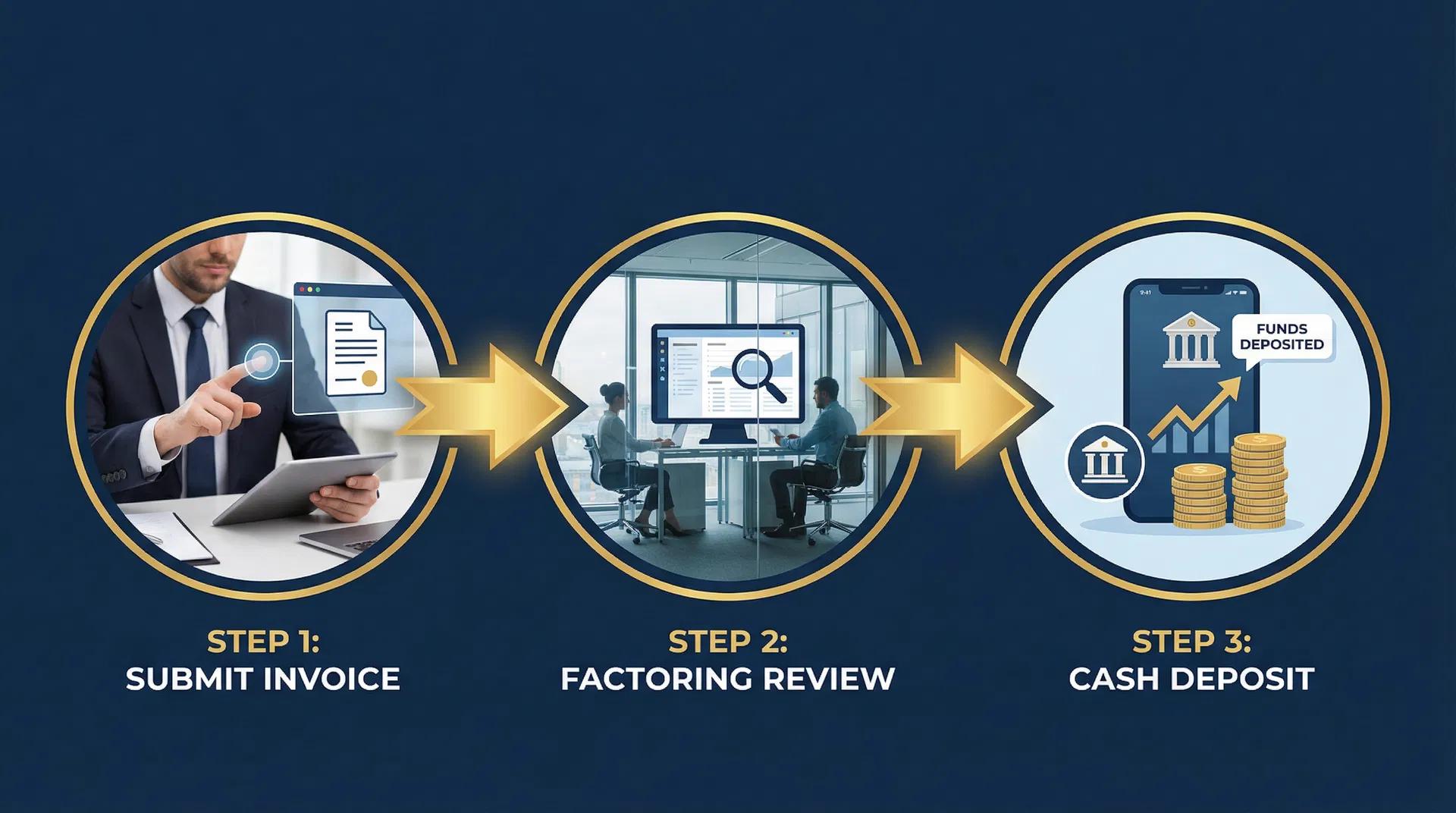
Step 2: You Submit Invoices to the Factoring Company
Rather than waiting for customer payment, you submit your invoices to a factoring company. This submission typically occurs through an online portal, making the process quick and convenient. You can choose which invoices to factor and when, providing flexibility to manage your cash flow strategically.
The factoring company verifies the invoices, confirming that:
- The work has been completed or goods delivered
- No disputes exist regarding quality or delivery
- The invoice amounts and payment terms are clear
- Your customer has a history of reliable payments
This verification process usually completes within hours, not days or weeks like traditional loan applications.
Step 3: You Receive an Immediate Cash Advance
Once verified, the factoring company advances you a percentage of the invoice value—typically 80-90%. This advance arrives in your bank account within 24-48 hours, providing immediate working capital to address your business needs.
For example, if you factor a $10,000 invoice with an 85% advance rate, you receive $8,500 immediately. This cash is yours to use as needed: covering payroll, purchasing inventory, paying suppliers, or investing in marketing and growth initiatives.
Importantly, this transaction is not a loan. You're selling your accounts receivable asset to the factoring company, so no debt appears on your balance sheet and no interest accrues over time.
Step 4: The Factoring Company Collects Payment
The factoring company now owns the invoice and assumes responsibility for collecting payment from your customer. When the payment terms arrive (30, 60, or 90 days), your customer pays the factoring company directly.
This collection process operates professionally and maintains your customer relationships. Reputable factoring companies understand that your customers are valuable business relationships and treat them accordingly.
Step 5: You Receive the Remaining Balance
Once your customer pays the invoice in full, the factoring company remits the remaining balance to you, minus their factoring fee. Continuing our example:
- Original invoice value: $10,000
- Initial advance (85%): $8,500
- Customer payment: $10,000
- Factoring fee (3%): $300
- Final payment to you: $1,200
Your total proceeds equal $9,700 ($8,500 + $1,200), and you received the majority of this amount immediately rather than waiting 30-90 days.
Types of Invoice Factoring
Factoring arrangements come in several forms, each with distinct characteristics and risk profiles.
Recourse vs. Non-Recourse Factoring
Recourse factoring represents the most common arrangement. If your customer fails to pay the invoice, you must buy it back from the factoring company or replace it with another invoice of equal value. This structure typically offers lower fees because you retain the credit risk.
Non-recourse factoring transfers the credit risk to the factoring company. If your customer becomes insolvent and cannot pay, the factoring company absorbs the loss. This protection comes at a higher cost, typically 0.5-1% more than recourse factoring.
However, non-recourse protection usually includes specific conditions and doesn't cover all non-payment scenarios. Disputes over work quality, delivery issues, or customer dissatisfaction typically remain your responsibility even in non-recourse arrangements.
Notification vs. Non-Notification Factoring
Notification factoring (also called disclosed factoring) operates transparently. Your customers know that a factoring company handles collections, and they make payments directly to the factor. This represents the standard approach and typically offers better rates.
Non-notification factoring (also called confidential factoring) keeps the factoring arrangement private. Customers continue sending payments to you, and you forward them to the factoring company. This discretion costs more and requires additional trust and administrative work.
Spot Factoring vs. Contract Factoring
Spot factoring allows you to factor individual invoices on an as-needed basis without ongoing commitments. This flexibility appeals to businesses with occasional cash flow needs, but typically comes with higher fees.
Contract factoring establishes an ongoing relationship where you commit to factoring a minimum volume of invoices over a specified period. This commitment usually secures lower fees and better terms, making it more cost-effective for businesses with consistent factoring needs.
Factoring Fees and Costs
Understanding factoring costs requires looking beyond simple percentages to consider how fees are structured and calculated.
How Factoring Fees Work
Factoring companies typically charge fees in one of two ways:
Flat fee structure: A single percentage applied to the invoice value regardless of how long the customer takes to pay. For example, a 3% fee on a $10,000 invoice costs $300 whether the customer pays in 15 days or 45 days.
Variable fee structure: A base fee plus additional charges for extended payment periods. For example, 1% for the first 30 days, plus 0.5% for each additional 15-day period. This structure incentivizes faster customer payments.
Factors Affecting Your Rate
Several variables influence the factoring fees you'll pay:
Invoice volume: Higher monthly volume typically secures lower rates. Factoring $100,000 monthly usually costs less per invoice than factoring $10,000 monthly.
Customer creditworthiness: Invoices from creditworthy customers with strong payment histories command better rates than those from customers with spotty payment records.
Industry: Some industries carry higher risk or require more specialized knowledge, affecting rates. Staffing and trucking often receive favorable rates due to high volume and standardized invoicing.
Invoice size and payment terms: Larger invoices with shorter payment terms (net 30) typically receive better rates than smaller invoices with extended terms (net 90).
Recourse vs. non-recourse: Non-recourse factoring costs more due to the additional risk the factoring company assumes.
Additional Fees to Consider
Beyond the basic factoring fee, some companies charge:
- Application or setup fees: One-time charges for establishing the relationship
- Due diligence fees: Costs for verifying your customers' creditworthiness
- Wire transfer fees: Charges for expedited fund transfers
- Monthly minimum fees: Charges if you don't meet minimum factoring volume
- Termination fees: Penalties for ending the contract early
Reputable factoring companies disclose all fees upfront. At Zeus Commercial Capital, we ensure you understand the complete cost structure before committing to any factoring arrangement.
Qualification Requirements
Invoice factoring focuses primarily on your customers' creditworthiness rather than your business credit, making it accessible to a broader range of businesses than traditional loans.
What Factoring Companies Look For
B2B invoicing: Most factors work exclusively with business-to-business transactions. Your customers should be other businesses, government entities, or institutions—not individual consumers.
Creditworthy customers: Your customers should have established businesses with reliable payment histories. The factoring company will verify their creditworthiness before approving invoices.
Clear, unencumbered invoices: The invoices must be free of liens, disputes, or complications. Work must be completed, goods delivered, and customers satisfied.
Minimum volume requirements: Most factors require minimum monthly invoice volume, typically ranging from $10,000 to $50,000, though this varies by company and industry.
Time in business: While less stringent than bank requirements, most factors prefer businesses operating for at least 3-6 months with established customer relationships.
What Matters Less Than You Think
Unlike traditional financing, these factors carry less weight in factoring approval:
- Your personal credit score: While not irrelevant, your credit matters far less than your customers' payment reliability
- Profitability: Factoring companies focus on invoice quality, not whether your business is currently profitable
- Collateral: Your invoices serve as the collateral; additional assets aren't typically required
- Business plan: Factors care about current invoices, not long-term growth projections
This accessibility makes factoring particularly valuable for startups, growing businesses, and companies recovering from financial challenges.
Industries That Benefit Most from Factoring
While invoice factoring works across many sectors, certain industries find it particularly advantageous.
Trucking and Transportation
Transportation companies face significant cash flow challenges due to:
- Fuel and maintenance costs that must be paid immediately
- Broker and shipper payment terms extending 30-90 days
- The need to keep trucks moving to remain profitable
Factoring enables trucking companies to cover fuel, repairs, and driver pay without waiting for broker payments. The transportation industry represents one of the largest users of invoice factoring services.
Staffing and Recruiting
Staffing agencies must pay employees weekly or biweekly while clients often pay on net 30 or net 60 terms. This creates a substantial cash flow gap that grows as the agency places more workers.
Factoring provides the working capital to meet payroll obligations while waiting for client payments, enabling staffing agencies to grow without cash flow constraints.
Manufacturing
Manufacturers invest heavily in raw materials, labor, and overhead before receiving payment for finished goods. Extended payment terms from distributors and retailers can strain cash flow, limiting production capacity.
Factoring converts completed orders into immediate cash, enabling manufacturers to purchase materials for new orders and maintain continuous production.
Wholesale and Distribution
Distributors operate on thin margins and high volume, making cash flow management critical. They must pay suppliers quickly to maintain favorable terms while extending credit to retailers.
Factoring bridges this gap, providing capital to purchase inventory and fulfill orders without depleting cash reserves.
Professional Services
Consulting firms, IT services, and other professional service providers often complete projects over weeks or months before invoicing. Payment terms then extend an additional 30-60 days.
Factoring enables these businesses to cover payroll and operational expenses without waiting months for project completion and payment.
Benefits Beyond Immediate Cash
While immediate cash flow represents the primary benefit, invoice factoring offers additional advantages that support business growth and stability.
Scalable Funding
Unlike fixed credit lines or term loans, factoring grows with your business. As you generate more invoices, you have access to more capital—automatically and without reapplying or renegotiating terms.
This scalability proves invaluable for growing businesses that would otherwise hit cash flow constraints when accepting larger orders or expanding into new markets.
Outsourced Credit Management
Many factoring companies provide credit checking services, evaluating your customers' creditworthiness before you extend credit. This protects you from bad debt and helps you make informed decisions about which customers to work with and what credit limits to establish.
Professional Collections
The factoring company handles invoice collection, freeing your staff to focus on core business activities rather than chasing payments. Professional factors maintain positive customer relationships while ensuring timely payment.
No Debt on Balance Sheet
Because factoring represents a sale of assets rather than borrowing, it doesn't create debt on your balance sheet. This preserves your borrowing capacity for other purposes and can improve financial ratios that banks and investors evaluate.
Flexible and Selective
You control which invoices to factor and when. During strong cash flow periods, you can collect payments directly. When cash flow tightens, you can factor invoices for immediate capital. This flexibility allows strategic cash flow management.
Potential Drawbacks to Consider
Invoice factoring offers powerful benefits, but it's not the right solution for every business or situation.
Customer Notification
In standard factoring arrangements, your customers know that a third party handles collections. While professional factors maintain positive relationships, some businesses prefer to keep financing arrangements private.
Cost Considerations
Factoring typically costs more than traditional bank loans when compared on an annualized basis. However, this comparison can be misleading because:
- You only pay for invoices you factor, not a full loan amount
- Approval is faster and more accessible
- No debt appears on your balance sheet
- The service includes credit management and collections
Customer Creditworthiness Dependency
Your funding capacity depends on your customers' credit quality. If your customers have poor credit or payment histories, you may not qualify for factoring or may receive less favorable terms.
Minimum Volume Requirements
Most factors require minimum monthly invoice volume. Very small businesses or those with irregular invoicing patterns may not meet these thresholds.
Working with Zeus Commercial Capital
Navigating the factoring landscape can be complex, with dozens of companies offering different terms, specializations, and service levels. This is where Zeus Commercial Capital provides exceptional value.
Our Brokerage Advantage
Rather than representing a single factoring company, we maintain relationships with an extensive network of factors across all industries. This enables us to:
Match you with the right factor: Different factors excel in different industries and situations. We leverage our knowledge to connect you with factors that understand your specific business challenges and offer optimal terms.
Secure competitive rates: Our volume and relationships enable us to negotiate rates that individual businesses typically cannot access on their own.
Provide ongoing support: We don't disappear after the initial placement. Our team remains available to address questions, resolve issues, and ensure your factoring relationship continues meeting your needs.
Save you time and effort: Instead of researching and contacting multiple factors yourself, we handle the legwork and present you with the best options for your situation.
Our Expertise Across Industries
Our team understands the unique challenges facing businesses in:
- Trucking and transportation: Fuel costs, broker relationships, and equipment financing
- Staffing and recruiting: Payroll timing, client payment terms, and seasonal fluctuations
- Manufacturing: Material costs, production cycles, and supply chain management
- Distribution: Inventory financing, supplier terms, and retail payment schedules
- Professional services: Project billing, retainer management, and consulting arrangements
This industry expertise ensures we match you with factors that understand your specific operational realities and can provide tailored solutions.
Getting Started with Invoice Factoring
If invoice factoring aligns with your business needs, getting started is straightforward.
Preparation Steps
Before applying, gather:
- Recent accounts receivable aging reports
- Sample invoices showing typical amounts and payment terms
- Customer list with payment history information
- Basic business information (formation documents, tax ID, etc.)
The Application Process
- Initial consultation: Discuss your business, cash flow needs, and customer base
- Application submission: Provide business and customer information
- Customer credit verification: The factor evaluates your customers' creditworthiness
- Terms proposal: Review advance rates, fees, and contract terms
- Agreement execution: Sign contracts and establish account procedures
- First funding: Submit invoices and receive your first advance
With Zeus Commercial Capital, this process typically completes within 3-5 business days, and you can receive your first advance within 24-48 hours of submitting invoices.
Conclusion
Invoice factoring transforms your accounts receivable into immediate working capital, solving cash flow challenges without creating debt. By understanding how factoring works—from the step-by-step process through fee structures and qualification requirements—you can make informed decisions about whether this financing solution supports your business objectives.
The key advantages of factoring include:
- Immediate access to cash tied up in invoices
- Qualification based on customer credit, not your credit score
- Scalable funding that grows with your business
- No debt on your balance sheet
- Professional credit management and collections
While factoring costs more than traditional bank loans on an annualized basis, it offers accessibility, speed, and flexibility that loans cannot match. For businesses with strong B2B customer bases and extended payment terms, factoring provides a powerful tool for managing cash flow and supporting growth.
At Zeus Commercial Capital, we specialize in matching businesses with ideal factoring solutions from our extensive provider network. Our expertise across industries and relationships with top factors ensure you receive competitive rates and terms tailored to your specific needs.
Ready to transform your cash flow with invoice factoring? Contact Zeus Commercial Capital at (800) 516-1153 [blocked] or check your eligibility [blocked] today. Our cash flow professionals are ready to answer your questions and connect you with the perfect factoring solution.
Related Resources:
- Compare invoice factoring vs. business loans [blocked] to determine the best financing option
- Explore our DSCR Calculator for real estate investment analysis
- Learn about Merchant Cash Advances for alternative funding options
- Discover DSCR loan solutions for investment property financing
- Connect with us on Facebook for industry insights and updates